Reverse Charge Mechanism (RCM) on SaaS: Startup Compliance Checklist
Understand how RCM applies to foreign software tool purchases (AWS, Slack, Github) and how to claim Input Tax Credit on these expenses.
Understanding RCM on SaaS Imports
Under the Indian GST framework, when you import services from an overseas supplier (e.g., Slack, GitHub, Amazon Web Services, or OpenAI), the supplier does not charge Indian GST. Instead, the liability to pay GST shifts to the recipient in India. This is called the Reverse Charge Mechanism (RCM).
Startups often overlook this requirement, which can result in interest and penalties during a tax audit.
The Import Checklist
- Identify foreign payments made on credit cards or wire transfers for overseas software tools.
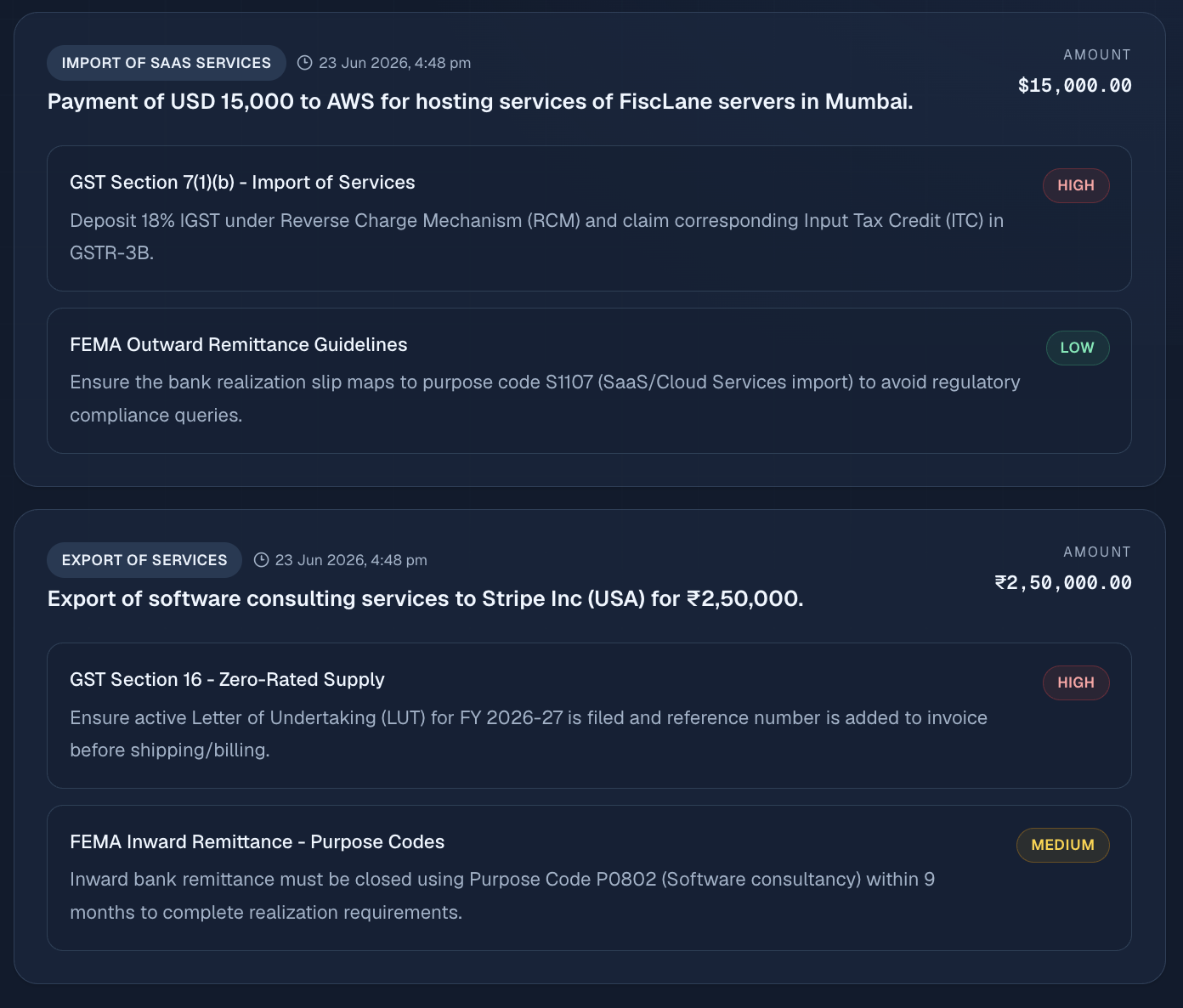
- Pay 18% IGST under the reverse charge mechanism via your monthly GSTR-3B return.
- Issue a self-invoice for the RCM transaction.
- Claim the paid IGST as Input Tax Credit (ITC) in the same return cycle (if eligible).
Verify your SaaS invoices using FiscLane''s Document Comparator to identify RCM exposure and generate compliance checklists automatically.
Unreconciled credit card transactions represent the highest audit trigger for emerging startups.
Statutory Compliance & GST Export Framework
Under Section 16 of the Integrated Goods and Services Tax (IGST) Act, 2017, export transactions are categorized as Zero-Rated Supplies. This legal position allows exporters to conduct business operations without tax liability. However, to maintain this tax-exempt status, businesses must adhere strictly to the rules laid down in Rule 96A of the CGST Rules, 2017. Under this rule, you must either export under a Letter of Undertaking (LUT) in Form GST RFD-11 or pay the applicable integrated tax (IGST) upfront and later claim a refund of the paid tax. Read more on filing and invoicing in our LUT Witness & Invoice Setup Guide.
Filing the Letter of Undertaking (LUT) is a mandatory step that must be completed prior to the commencement of export operations for each financial year. Exporters often make the mistake of issuing invoices with zero tax before filing the LUT. This omission is flagged during tax audits, resulting in demand notices from the department. The LUT is valid only for a single financial year (from April 1 to March 31), and a fresh application must be submitted online on the official GST Portal (gst.gov.in) at the start of every new fiscal period to prevent compliance disruptions.
Additionally, the place of supply for cross-border services must be determined in accordance with Section 13 of the IGST Act. In most cases involving remote consultancy, software development, and digital marketing, the Place of Supply is the location of the recipient outside India. However, if the services are classified as intermediary services (where the exporter merely facilitates a supply between two parties), the Place of Supply shifts to India, making the transaction subject to 18% IGST. Understanding this distinction is vital for digital agencies to avoid audit assessments, as discussed in our analysis of the GST Place of Supply rules.
Step-by-Step GST Portal Navigation for RFD-11
To file the Letter of Undertaking on the GST portal, follow this precise navigation pathway:
- Log into the GST Portal using your registered tax credentials.
- Navigate to the top menu and select Services > User Services > File LUT (RFD-11).
- Select the correct Financial Year for which you are submitting the LUT from the drop-down menu.
- If you have previously filed an LUT for the prior financial year, upload the previous LUT ARN receipt as supporting evidence.
- Fill in the declaration check-boxes confirming that you will realize export proceeds within the mandated timeline.
- Enter the details (Name, Address, PAN, and signatures) of two independent witnesses. Ensure their details match their official tax records. You can download the template from our LUT Witness affidavit guide.
- Sign the application using your Digital Signature Certificate (DSC) or through Electronic Verification Code (EVC) OTP, then click submit.
Once submitted, the portal will generate an Application Reference Number (ARN) receipt. You must print this ARN number on all your commercial export invoices to satisfy customs and bank compliance officers during audits.
Reverse Charge Mechanism (RCM) & SaaS Import Rules
Under Section 9(3) and 9(4) of the CGST Act, 2017, the liability to pay GST shifts from the supplier to the recipient in specific transactions. This is known as the Reverse Charge Mechanism (RCM). When an Indian business imports services from an overseas provider (such as Slack, GitHub, Amazon Web Services, or OpenAI), the foreign vendor does not charge Indian GST. Instead, the importing business in India must self-assess the 18% IGST and pay it to the government. Read our Startup RCM Checklist.
A common mistake made by startups and digital agencies is failing to declare and pay RCM on foreign SaaS tool purchases. During audits, tax officers review bank statements and credit card logs to identify payments made to overseas entities. If they detect non-payment of RCM, they issue notices demanding the tax amount plus 18% interest under GST Section 50. Paying the RCM tax is mandatory even if the business is eligible to claim the paid amount back as Input Tax Credit (ITC), as explained in our Google & Meta Ads RCM Guide.
Under GST rules, the recipient of RCM services must issue a **Self-Invoice** under Section 31(3)(f) of the CGST Act. The self-invoice details the supplier's address, transaction value, and the applicable IGST rate. Once the tax is paid in the monthly GSTR-3B return, the business can claim the matching input credit in Table 4 of the same return, completing the compliance loop.
Step-by-Step RCM Reporting in GSTR-3B
To declare and reconcile RCM payments in your monthly GSTR-3B return, complete these steps:
- Reconcile credit card statements and bank wires to identify payments made to foreign software or service providers.
- Generate self-invoices for each RCM transaction and charge the 18% IGST.
- Declare the total RCM taxable value and IGST liability in Table 3.1(d) (Inward supplies liable to reverse charge) of GSTR-3B on the GST Portal.
- Pay the tax amount using the cash ledger (RCM liabilities cannot be settled using input tax credits).
- Claim the paid IGST as Input Tax Credit in Table 4(A)(3) (Inward supplies liable to reverse charge) of the same return.
- Ensure all entries match your purchase ledger to pass GSTR-9 annual audits.
FEMA & RBI Regulatory Inward Remittance Guidelines
The Foreign Exchange Management Act (FEMA) regulates all cross-border transactions in India. The Reserve Bank of India (RBI) mandates that all export proceeds, including earnings from software development, SaaS sales, and consulting services, must be repatriated to India within a strict timeline (currently nine months for goods and services). Failing to bring foreign currency into your local bank account inside this window constitutes a severe foreign exchange violation, subject to significant penalties from the RBI. Read the details in our FEMA 2026 consolidation guidelines.
When foreign exchange is received in India, the Authorized Dealer Category-I (AD Cat-I) bank is responsible for reporting the transaction to the RBI. This reporting relies on selecting the correct FEMA Purpose Code. The purpose code classifies the nature of the transaction (e.g., P0802 for software implementation services, P0807 for data hosting, and P1006 for general business support services). Mismatches between your invoice description and the selected banking purpose code will cause transaction holds or trigger scrutiny during tax reviews. Check the correct codes in our Freelance Purpose Codes Guide.
Furthermore, payment aggregators like Stripe, Wise, and PayPal process transactions through partner banks in India, which generate electronic Foreign Inward Remittance Advices (e-FIRAs). Exporters must actively download these advices to prove the source of funds during GST audits. FiscLane provides automated reconciliation dashboards to match banking remittance details with commercial invoices, making it easy to spot errors before they result in compliance failures. Learn more in our Wise & Stripe e-FIRA download walkthrough.
FEMA Compliance Checklist for Service Exporters
To ensure full compliance with FEMA and RBI regulations, service exporters should follow this verification checklist:
- Verify Purpose Codes: Confirm that the banking remittance profile uses the correct purpose code corresponding to the services detailed in client agreements.
- Realization Timeline: Track payment collection dates to ensure all foreign invoices are settled within the nine-month FEMA window.
- Download e-FIRAs: Download the electronic FIRA/FIRC documents from your payment processor within 15 days of settlement.
- EEFC Account Utilization: Open an Exchange Earners Foreign Currency (EEFC) account to hold foreign currency and avoid daily conversion losses.
- FDI Reporting: Ensure any foreign equity investments are reported on the official RBI FIRMS Portal (firms.rbi.org.in) within 30 days of share allotment.
Frequently Asked Questions (FAQs)
1. What is the penalty for not filing an LUT before service exports?
If you export services without an active LUT, the transaction is treated as a domestic inter-state supply, making it subject to 18% IGST. You must pay this tax out-of-pocket and then apply for a refund using Form RFD-01. Delayed payments will also attract interest charges at 18% per annum under Section 50 of the CGST Act. Refer to the GST portal guidelines.
2. Can I receive export proceeds in Indian Rupees (INR)?
Under FEMA guidelines, export proceeds must generally be received in convertible foreign exchange (such as USD, EUR, or GBP). However, payments in INR are permitted if they are routed through Vostro accounts of foreign banks or are received from specific countries as notified by the Reserve Bank of India (RBI). Verify details on the official RBI Website (rbi.org.in).
3. Is a Tax Residency Certificate (TRC) mandatory for DTAA claims?
Yes, Section 90(4) of the Income Tax Act states that a taxpayer cannot claim DTAA benefits unless they obtain a valid Tax Residency Certificate (TRC) from their home country's tax authority. Foreign clients will deduct the default 30% withholding tax if the TRC is missing. Read our Form 10F online filing guide.
4. Can I claim Input Tax Credit on RCM payments immediately?
Yes, you can claim the Input Tax Credit (ITC) for RCM payments in the same monthly return cycle in which the liability is declared and settled, provided the service is used for business operations and is not blocked under Section 17(5). Read the Startup RCM Checklist for full reconciliation checks.
CA Amit Sharma
Verified Advisory LeadAmit is a Chartered Accountant (ICAI membership #409214) and FEMA compliance advisor with over 8 years of experience advising technology startups, digital marketing agencies, and remote professionals on zero-rated GST exports, DTAA declarations, and RBI inward remittance audits.
Disclaimer: The information provided above is for educational purposes only and does not constitute formal legal or financial advice. Please verify details using official circulars issued by the Central Board of Indirect Taxes & Customs (CBIC) and RBI.